
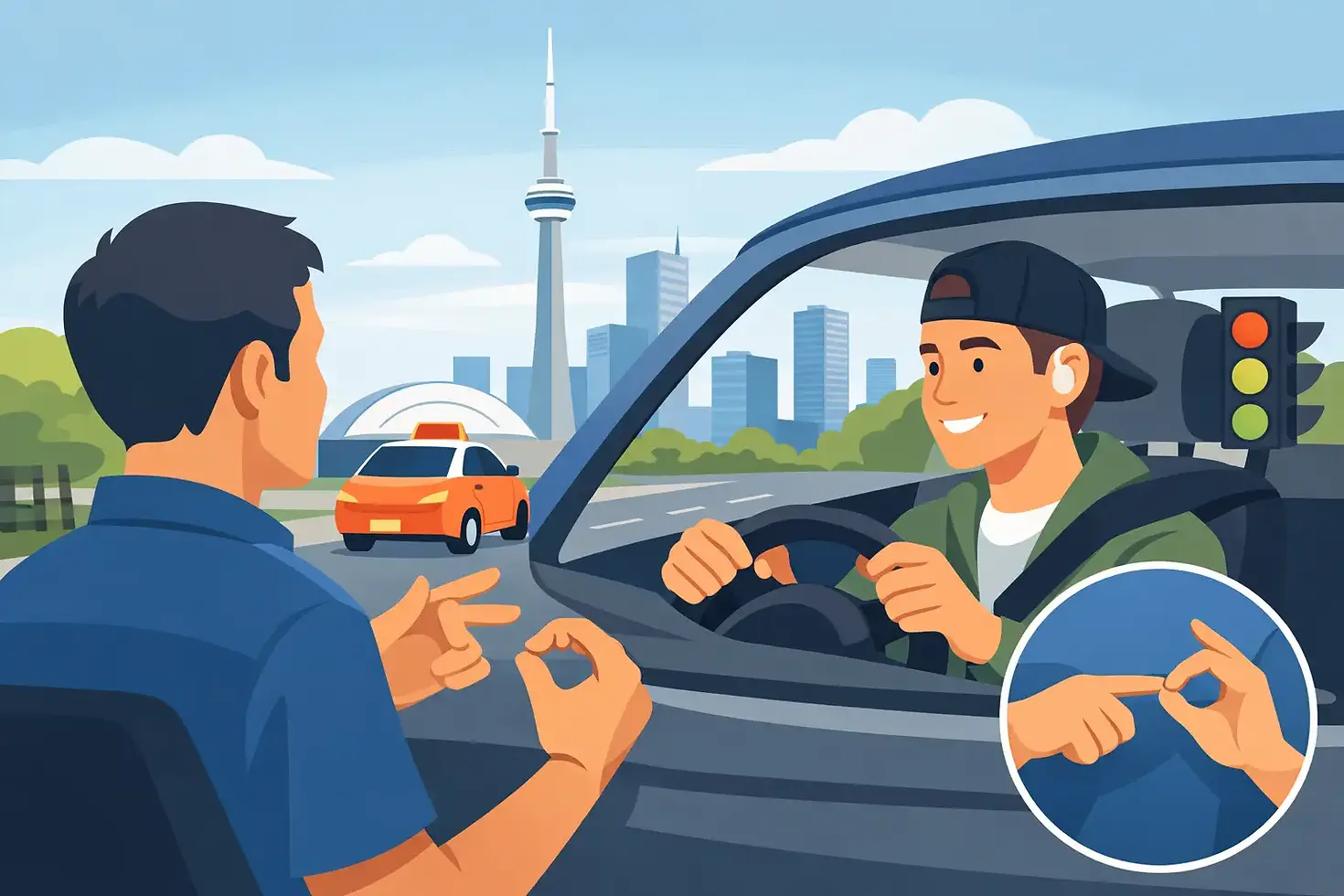
Deaf Driving Lessons Toronto Done Right
- Jun 6
- 6 min read
Finding deaf driving lessons Toronto students can actually rely on is harder than it should be. Too many schools say they are "inclusive" until real communication needs show up in the car. Then the lesson slows down, the student gets blamed for confusion, and confidence drops fast.
That is not good enough. Deaf and hard of hearing students do not need watered-down instruction. They need proper instruction - clear, patient, adaptive, and built around how they communicate best. When that happens, learning to drive becomes exactly what it should be: structured, practical, and achievable.
What makes deaf driving lessons in Toronto different
Driving is visual, but driving instruction is not only visual. A weak instructor depends heavily on constant verbal correction, rushed explanations, and generic teaching habits. That approach breaks down quickly with deaf learners, especially when the instructor has no plan for visual cues, pre-lesson briefings, route preparation, or in-car communication.
Effective deaf driving lessons in Toronto require more than goodwill. They require a method. The instructor needs to know how to explain skills before the vehicle moves, how to use agreed signals safely, and how to correct mistakes without creating stress or confusion. They also need the patience to repeat, adjust, and teach at the student’s pace without talking down to them.
This is where experience matters. Specialized instruction is not something an inexperienced part-time instructor can improvise. A student may be learning lane changes, left turns, mirror checks, and road test standards all at once. If communication is unclear, the problem is not the student. The problem is the lesson design.
Clear communication matters more than promises
A lot of learners and families ask the same question: can a deaf student learn to drive safely in Toronto traffic? Yes, absolutely. But the quality of instruction makes a major difference.
The right approach starts before the engine turns on. The lesson should include a clear plan for communication, whether that is sign language, written notes, visual prompts, demonstration, or a combination of methods. Every student is different. Some deaf students prefer direct signing. Others rely more on lip reading, texting before and after lessons, visual demonstrations, or step-by-step written reinforcement.
There is no single formula, and that is exactly the point. Good instruction is adapted. Bad instruction is standardized and then defended when it does not work.
In Toronto, where learners face dense traffic, complex intersections, streetcars, pedestrians, cyclists, and fast-changing road conditions, clarity is not optional. Students need to know exactly what is expected during turns, merges, school zones, residential scanning, and highway entry. If an instructor cannot communicate those skills clearly, the lesson wastes time and money.
What deaf students should expect from a quality instructor
A qualified instructor should be calm, consistent, and prepared. That sounds basic, but it is often where many schools fail. Patience is not just being nice. Patience means allowing time for understanding, checking that instructions were received correctly, and adjusting the lesson without making the student feel rushed.
Students should also expect practical teaching, not vague encouragement. "You’re doing fine" is not enough if mirror checks are late or the turn is too wide. Strong instructors give precise feedback in a way the student can actually process. They break skills into parts, practise them repeatedly, and correct unsafe habits early.
For deaf learners, that often means using more pre-driving explanation and more post-manoeuvre review. It may also mean stopping briefly when needed to clarify a concept rather than pushing through confusion. That is not a setback. It is efficient teaching.
Families often assume the biggest issue will be hearing traffic sounds. In reality, many deaf drivers develop very strong visual awareness because they are trained to scan effectively and anticipate movement. The real issue is whether the instructor knows how to teach road awareness in a way that builds confidence instead of anxiety.
Deaf driving lessons Toronto families can trust
When families search for deaf driving lessons Toronto schools offer, they are usually not just comparing prices. They are looking for safety, credibility, and respect. They want to know their son, daughter, or family member will not be treated like a difficult case just because standard teaching methods are not enough.
That concern is valid. Specialized instruction should never feel like an afterthought. It should feel like the school has done this before and knows how to get results.
A capable school will understand that progress may look different from one student to the next. Some learners become road-ready quickly once communication clicks. Others need more repetition in high-pressure situations like downtown left turns, lane changes on major roads, or parking under test conditions. Neither situation is unusual. What matters is having an instructor who can read the student accurately and teach accordingly.
This is also why bargain shopping can backfire. A low-cost lesson with an instructor who lacks specialized experience often ends up costing more in the long run. Repeated confusion, poor habits, missed test standards, and avoidable road test failures add up fast. Experience saves time.
Road test preparation is not separate from communication
One mistake many schools make is treating adaptive instruction and road test preparation as two different services. They are not. The same communication method that helps a student learn basic driving is also what helps them prepare for the G2 or G road test properly.
Road test success depends on consistency. The student needs to understand examiner expectations, common reasons for deductions, and how to perform key skills under pressure. That includes observation routines, speed control, lane discipline, intersection decisions, parking, and defensive driving habits.
For deaf students, preparation should be direct and realistic. There should be no guessing about what will happen on test day. A good instructor explains the format, practises common routes where appropriate, and focuses on the patterns that examiners watch closely. If the student struggles in one area, the lesson plan should narrow in on that weakness instead of repeating the same generic drive.
That practical focus matters whether the learner is a teenager starting from scratch, an adult returning to driving, or a newcomer adapting to Ontario rules. Each group brings different strengths and different habits. Teaching has to account for that.
Why local Toronto experience matters
Toronto is not an easy city to learn in. That is exactly why local experience counts. Instructors need to understand the rhythm of the roads in Scarborough, North York, Etobicoke, and across Toronto more broadly. They should know how to build a student from quieter residential practice into heavier traffic, complex intersections, and road test conditions without pushing too far too soon.
A student who can manage basic turns on a calm side street is not automatically ready for a major arterial road at rush hour. On the other hand, keeping a learner in easy conditions for too long can delay progress. Good teaching is about timing. You challenge the student enough to improve, but not so much that every lesson becomes overwhelming.
That balance is especially important for students who have already had a poor experience elsewhere. Some come in discouraged because an instructor was impatient or because communication broke down repeatedly. Rebuilding confidence takes skill. It also takes honesty. If a student is test-ready, they should be told. If they are not ready, they should be told that too, with a clear plan to get there.
Driving 101 Driving School has built its reputation on exactly that kind of instruction - patient, specialized, and grounded in real teaching experience rather than convenience-based booking platforms that treat every learner the same.
Choosing the right school
If you are comparing schools, ask direct questions. Do they have real experience teaching deaf students? How do they handle in-car communication? Do they adapt lessons for the individual, or do they simply promise to "try their best"? Can they provide structured G2 and G road test preparation, not just basic driving time?
The answers will tell you a lot. A school with genuine expertise will sound clear and confident, not vague. They will understand that accessible instruction is not a bonus feature. It is a core part of teaching properly.
The right lesson should leave the student more confident, more skilled, and more aware of what to improve next. That is the standard. Anything less is not specialized instruction.
For deaf learners in Toronto, the goal is not just getting a licence. It is becoming a safe, independent driver with the right habits from the start. With patient teaching, strong communication, and an instructor who knows how to adapt, that goal is well within reach.


Comments