
How to Use Roundabouts in Ontario Safely
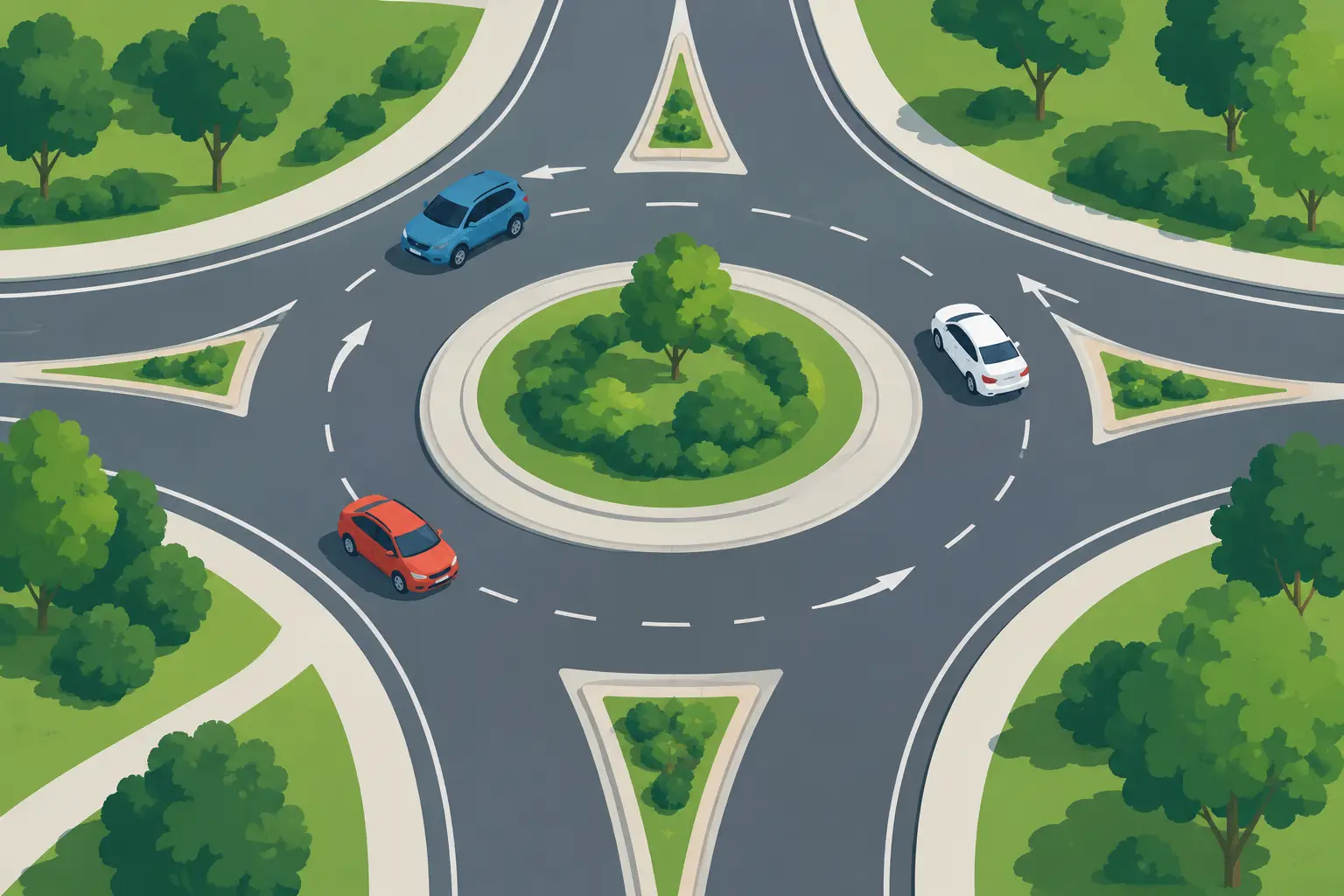
A roundabout can feel easy when you are watching someone else drive through it. From the driver’s seat, with cars approaching from several directions and a road test examiner watching, it can feel very different. Learning how to use roundabouts in Ontario comes down to one habit: slow down early, read the signs, and yield before you enter.
Roundabouts are designed to keep traffic moving while reducing the severity of many intersection crashes. They do not work when drivers rush the entry, choose a lane at the last second, or stop inside the circle because they are unsure. The good news is that the same clear routine works at most Ontario roundabouts, whether you are driving in the GTA, a smaller community, or an unfamiliar area before your G2 or G road test.
How to Use Roundabouts in Ontario: The Basic Routine
As you approach a roundabout, reduce your speed well before the yield line. Look for the advance sign showing the exits and lane arrows. At a single-lane roundabout, the decision is simple: enter only when there is a safe gap in traffic already circulating.
Traffic inside the roundabout has the right-of-way. You must yield to vehicles coming from your left that are already in the circle. Do not treat the yield sign as a stop sign. Stop only when traffic, a pedestrian, cyclist, or another road user makes it necessary. If the way is clear, continue smoothly into the roundabout.
Once inside, keep moving at a controlled speed and stay in your lane. You do not stop to let another vehicle enter. Drivers waiting at the next entrance must yield to you.
When you reach your exit, signal right and leave the roundabout carefully. Check the crosswalk at the exit for pedestrians and cyclists before proceeding. This is one of the most commonly missed observations during lessons and road tests: a driver focuses on leaving the circle but forgets that someone may be crossing immediately after it.
Choose Your Lane Before You Enter
Multi-lane roundabouts require more planning. The signs, pavement arrows, and lane markings tell you which lane to use for each exit. Read them early. Last-second lane changes near the yield line create confusion and can cause a collision.
A common layout uses the right lane for the first exit and sometimes for going straight, while the left lane may be used for later exits or turning left. But there is no single rule that applies to every multi-lane roundabout. The posted signs and arrows at that location always control your choice.
If you are taking the first exit, you will usually use the right lane. If you are going straight, follow the signs to determine whether the right or left lane is permitted. If you are taking a later exit or making what feels like a left turn, the left lane is often required. Enter in the correct lane, remain in it through the roundabout, and exit only where your lane allows.
Do not change lanes inside a roundabout unless lane markings specifically guide you to do so and it is clearly safe. In practice, the safest approach for new drivers is to make the lane decision before entering. If you miss your exit, continue around again rather than forcing a lane change or cutting across another vehicle’s path. Going around one more time is never a failure. Creating a dangerous situation to avoid it is.
Signalling Without Overthinking It
Your most useful signal at a roundabout is the right signal when you are leaving. Signal right after you pass the exit immediately before the one you want. That gives drivers waiting to enter a clear indication that you are exiting.
For example, if you are taking the second exit, pass the first exit, signal right, check the crosswalk, and exit. If you are taking the first exit, signal right as you approach and maintain that signal through the exit.
Some drivers signal left while approaching or circulating to show they intend to take a later exit. This can be confusing, particularly for new drivers. Follow the guidance given by your instructor and any lane-control signs at the intersection, but never let signalling distract you from yielding, lane position, and pedestrian checks. A correct signal does not give you the right-of-way.
Pedestrians, Cyclists, and Large Vehicles Need Space
Roundabouts are not only about cars. At every entry and exit, scan the crosswalk. Pedestrians have the right to cross when it is safe and permitted, and drivers must yield as required. Do not block a crosswalk while waiting for traffic to clear.
Cyclists may ride through the roundabout as vehicles or use a designated crossing, depending on the design and their position. Give them room and avoid passing them within the circle. Their speed may be different from yours, and sudden movement in a roundabout leaves little space to recover safely.
Be especially patient around buses, delivery vehicles, and transport trucks. Large vehicles may need extra room to turn and may use a truck apron, which is the raised paved area around the centre island. Do not try to squeeze beside a large vehicle or pass it in the roundabout. Stay back, let it complete the turn, and keep your vehicle visible.
If an emergency vehicle approaches while you are waiting to enter, pull over safely and let it pass before entering if possible. If you are already inside the roundabout, do not stop in the circulating lane. Exit first, then pull over when it is safe to do so.
Roundabout Mistakes That Cost Drivers on Road Tests
Road test examiners are not looking for perfection. They are looking for safe, predictable driving and proper observation. At a roundabout, that means your approach matters as much as your exit.
The most common error is entering too quickly. A fast approach reduces the time you have to see the yield sign, choose the correct gap, notice a pedestrian, and make a calm decision. Ease off the accelerator early and cover the brake as needed. This shows control, not hesitation.
Another common issue is waiting too long for a gap. You must yield to circulating traffic, but you do not need an enormous empty space. Learn to judge whether the approaching vehicle is far enough away for you to enter without making it brake or change speed. Your instructor can help you build that judgment through repeated practice at different traffic levels.
Other errors include failing to check the exit crosswalk, drifting across lane markings, entering from the wrong lane, and stopping inside the roundabout. These mistakes often happen because a driver is focused on one task only. Use a steady visual routine: signs and lane arrows on approach, traffic to the left at the yield line, then your lane position and the exit crosswalk.
What If You Miss Your Exit?
Stay calm and keep circulating. Do not reverse, stop suddenly, or cut across lanes. Complete another loop and exit when you are properly positioned. On a road test, a missed exit is usually far less serious than an unsafe correction.
This is also a useful mindset for anxious drivers. You do not have to make a rushed decision just because another driver is behind you. Drive legally, yield correctly, and take the safe option. A driver who honks does not get to decide whether your gap is safe.
Practice Builds Real Confidence
Roundabouts are learned through repetition, not guesswork. Start with a quiet single-lane roundabout where you can practise the basic sequence: approach slowly, read the signs, yield to circulating traffic, enter smoothly, signal right, and check the exit crosswalk.
Then move to busier locations and multi-lane designs. Practise different exits, different lane assignments, night driving, rain, and heavier traffic. The goal is not to memorize one intersection. The goal is to build a routine that works anywhere in Ontario.
New drivers, newcomers, seniors refreshing their skills, and drivers with anxiety or attention-related challenges may need more structured repetition. That is normal. Patient instruction should break the task into manageable decisions instead of expecting you to “just get used to it.” Driving 101 Driving School teaches roundabout skills with clear coaching, local practice, and strategies matched to the learner, including drivers who need a more individualized approach.
The next time you approach a roundabout, give yourself time. Read the lane signs early, yield to traffic already inside, hold your lane, and make a full pedestrian check before exiting. Safe driving is not about being the fastest vehicle through the circle. It is about being the driver everyone else can predict.


Comments